
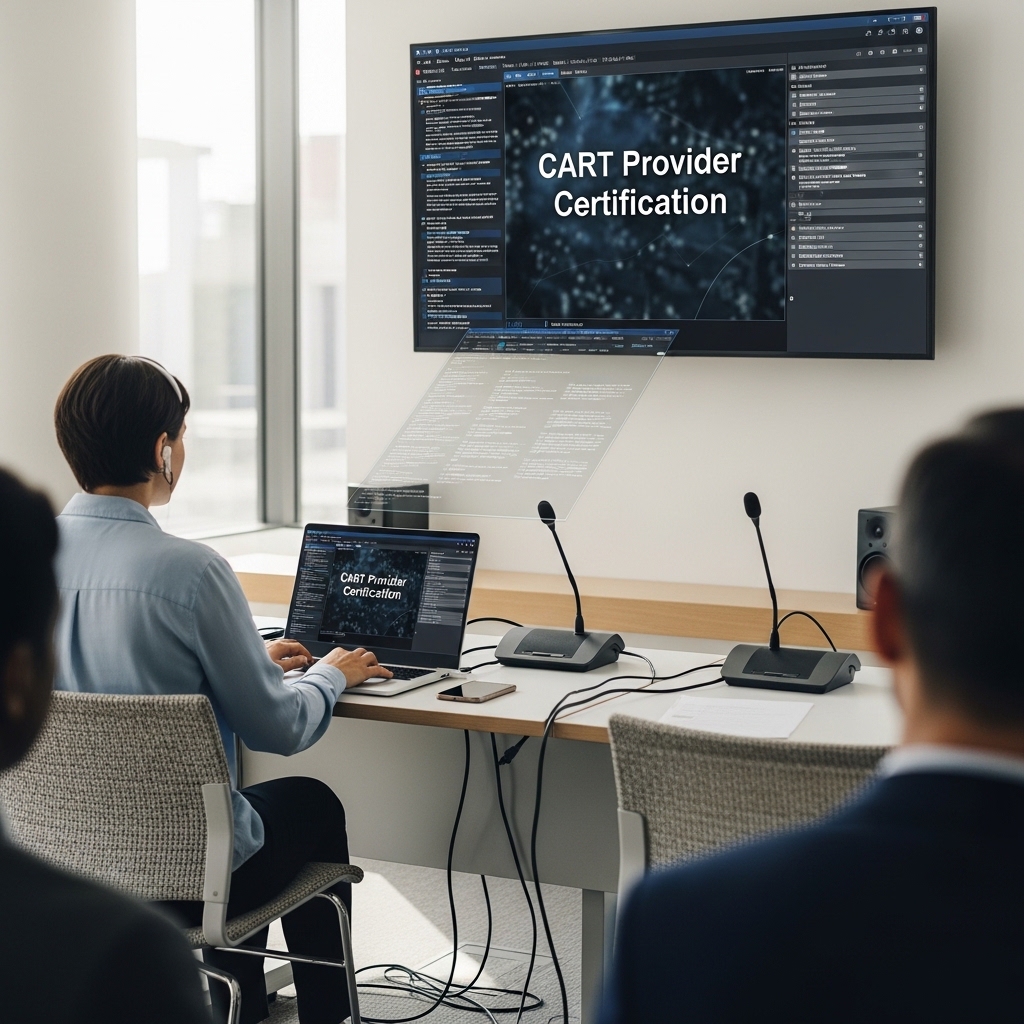

CART Provider Certification Preparation Course
The Comprehensive Examination Preparation Program for Court Reporters and Realtime Professionals Pursuing the Certified CART Provider (CCP) Credential
The CCP is the credential that opens the room.
Not metaphorically — literally. The Certified CART Provider credential opens the room where the board of education is purchasing communication access realtime translation services for deaf and hard-of-hearing students. The room where the state agency is selecting CART providers for public meetings. The room where the healthcare system is vetting realtime captioning for patient communication services. The room where the conference organizer is specifying credential requirements for their accessibility services contract.
In all of those rooms, the CART credential — the CCP credential specifically, or the equivalent credential recognized in the relevant jurisdiction — is the professional qualifier that separates the practitioner who can be considered from the practitioner who cannot. It is not always required. But it is increasingly expected. And in the contexts where it is expected without being specified as a hard requirement, the provider without it is competing at a disadvantage against providers who have invested in obtaining it.
The CCP examination requires the candidate to demonstrate both the realtime captioning accuracy required for CART work and the professional knowledge required to practice CART effectively in the complex accessibility context. Passing requires preparation that is specific to the examination’s requirements — not the same preparation that produces general transcription accuracy.
The Zburător Support CART Provider Certification Preparation Course is the structured curriculum for both components: the realtime accuracy development system and the CART professional knowledge examination preparation.
📥 Digital download from Zburător Support. All course materials available immediately.
THE COURSE CURRICULUM — MODULE BY MODULE
MODULE ONE: UNDERSTANDING THE CCP EXAMINATION
The Examination Structure and Requirements
The CCP examination administered by the National Court Reporters Association consists of two components that must both be passed for the credential to be awarded:
The skills component: The realtime captioning skills test demonstrating the ability to produce unedited realtime text at 98% accuracy or higher at speeds up to 180 WPM across two literary, two Q&A, and one jury charge passage. The skills test that differs from the RPR in its emphasis on unedited realtime accuracy — the ability to produce a text output suitable for immediate CART display, rather than a steno record that will be edited before delivery.
The written knowledge component: The sixty-question multiple-choice examination covering the CART provider’s professional knowledge: the legal and regulatory framework for CART and disability rights, the CART service delivery process, the technology systems and their configuration, the etiquette and professional practice standards, and the accessibility principles specific to the CART context.
The examination registration process, the testing site options (the in-person RPO test site versus the remote proctored option), the prerequisites (the RPR or equivalent credential requirement), and the examination scoring standards.
The CART Context and Professional Framework
The conceptual foundation for the entire course: what CART is, why it exists, and what the CART provider is professionally obligated to deliver. The distinction between CART and court reporting (the shared technical foundation and the different service context, the different client relationships, and the different professional obligations). The CART provider’s role in the accessibility ecosystem — the relationship with the deaf and hard-of-hearing client, the relationship with the requesting entity (the educational institution, the employer, the event organizer), and the legal framework that defines CART as a reasonable accommodation under applicable disability rights law. ⚖️
MODULE TWO: THE REALTIME ACCURACY DEVELOPMENT SYSTEM
The Unedited Realtime Standard — What It Actually Requires
The 98% accuracy standard for the CCP skills examination means that no more than 2% of words in the transcribed passage contain errors — steno errors, translation errors, or untranslated outlines. In a 200-word passage, that allows four words maximum. In the Q&A format where questions and answers alternate and the subject matter changes rapidly between exchanges, four errors can occur in a single poorly-translated question if the brief selection is wrong or the dictionary entry is inadequate.
The module begins with the accuracy audit: the diagnostic process for identifying where in the candidate’s current realtime performance the errors are concentrated. The patterns that typically emerge: the proper noun vulnerability (the names and specialized terms that are in the steno record but translate incorrectly because the dictionary entry was not built or was built with a spelling error), the brief conflict vulnerability (the brief that works in most contexts but conflicts with another entry in a specific word sequence), and the speed degradation accuracy vulnerability (the accuracy that is adequate at 160 WPM but degrades at 180 WPM because specific outlines become imprecise under speed pressure).
The Brief Building Strategy for Realtime Accuracy
The steno brief library development process specifically for CART and realtime work: the brief categories that most affect realtime accuracy in CART contexts (the personal pronoun chains, the modal verb combinations, the legal and procedural terminology for CART in legal settings, the educational terminology for CART in educational settings, the medical terminology for CART in healthcare settings), the brief construction principles for minimum conflict risk, and the integration and testing protocol for new briefs before they are relied upon in live CART sessions.
The brief audit: the review of the existing brief library for conflicts, for entries that produce incorrect translation in specific contexts, and for categories where the brief library is underdeveloped relative to the CART work contexts the candidate serves. 🎯
The Practice Material System
The organized practice curriculum for CCP skills test preparation:
The passage library: The practice passages for each of the three test formats — literary, Q&A, and jury charge — organized by difficulty level and subject matter. The progressive difficulty structure: the early preparation phase passages at speeds below the test standard with subjects in the candidate’s current comfort zone, the intermediate preparation phase at the test standard speed with subject matter at the edge of the candidate’s current dictionary and brief coverage, and the examination simulation phase at test conditions.
The weak spot targeting protocol: The practice methodology that concentrates drilling on the specific accuracy vulnerability patterns identified in the diagnostic audit rather than general-speed practice. The evidence base for targeted practice over general volume practice in improving accuracy for professional-level reporters.
The examination simulation protocol: The practice test administration system that replicates the examination conditions — the passage format, the speed, the five-minute duration, the unedited output review, and the error count and classification. The performance tracking that shows whether the preparation is on track for the 98% standard at the examination date.
MODULE THREE: THE WRITTEN KNOWLEDGE EXAMINATION PREPARATION
Domain One: Disability Rights Law and the CART Framework (18 questions on the examination)
The legal and regulatory framework governing CART as an accessibility service:
The Americans with Disabilities Act: The ADA’s application to CART services — the Title II coverage for government entities, the Title III coverage for places of public accommodation, the employment context under Title I, and the specific guidance on communication access for people who are deaf or hard of hearing. The reasonable accommodation standard and its application to CART service requests.
The Rehabilitation Act: Section 504’s requirements for programs receiving federal funding, the specific application to educational institutions and federally funded programs, and the complaint and enforcement process.
The Individuals with Disabilities Education Act (IDEA): The IDEA’s application to CART services for students in K-12 educational settings, the IEP process and CART as a related service, and the parental consent and documentation requirements.
The ADA Amendments Act (ADAAA): The expanded definition of disability under the ADAAA and its implications for CART accommodation requests.
The written knowledge examination preparation for this domain: the key definitions, the key standards, and the application scenarios that appear in examination questions. 📋
Domain Two: CART Service Delivery and Professional Practice (22 questions)
The professional knowledge and practice standards for CART delivery: the pre-session preparation (the client intake process, the glossary preparation, the technology setup verification), the session management (the positioning, the speaker identification, the interruption protocol, the technical failure management), the post-session responsibilities (the verbatim versus edited output standard for CART in different contexts, the file delivery, the confidentiality), and the ethical obligations of the CART provider (the impartiality standard, the confidentiality obligations, the conflicts of interest management).
The CART-specific professional scenarios that appear in the written knowledge examination, with the analysis framework for each.
Domain Three: Technology Systems and Configuration (12 questions)
The CART technology systems knowledge required for the written examination: the CAT software realtime configuration, the display system options and specifications, the network and connectivity requirements, the platform integration for remote CART delivery, and the troubleshooting knowledge for common technical failures in CART environments.
Domain Four: Accessibility Principles and Consumer Needs (8 questions)
The consumer perspective knowledge for CART providers: the diversity within the deaf and hard-of-hearing community (the distinctions that affect CART service preferences and requirements), the individual communication access needs assessment, the display preference consultation, and the client relationship management standards specific to the CART context. 🌟
MODULE FOUR: THE EXAMINATION STRATEGY AND PREPARATION TIMELINE
The Twelve-Week Preparation Calendar
The week-by-week preparation plan from enrollment through examination day: the skills component preparation schedule (the weekly accuracy benchmark, the passage hours per week, and the weekly diagnostic review), the written knowledge study schedule (the domain coverage sequence, the review cadence, and the practice examination schedule), and the integration phase in the final two weeks (the combined skills and knowledge review, the examination simulation, and the pre-examination preparation protocol).
The Examination Day Protocol
The logistics, the mental preparation, and the examination technique: the skills test preamble review and transcript setup, the approach to unfamiliar terminology in the test passages (the translation-to-dictionary protocol for the first encounter with an untranslated outline in a test passage), the written examination time management, and the answer review approach.
📂 COMPLETE ZBURĂTOR SUPPORT FILE SUITE
🎯 Complete CART Provider Certification Preparation Course PDF — all four modules | 📊 Realtime Accuracy Diagnostic Tool (editable) | 📝 Practice Passage Library — all three formats, progressive difficulty (PDF) | ✅ Written Knowledge Domain Study Guide — all four domains (PDF) | 📅 12-Week Preparation Calendar Template (editable) | 📋 Practice Examination — 60 questions with answer explanations (PDF) | 🌟 CART Professional Practice Standards Quick Reference (laminate-ready PDF)
100% digital. Instant download from Zburător Support. The preparation system that produces CCP candidates who pass — not candidates who almost pass.

Reviews
There are no reviews yet.